Selecting springs for high-temperature or corrosive applications requires far more than picking a standard component from a catalogue. In high-stakes fields like aerospace, medical device manufacturing, defence, and energy, choosing the right material is the foundation of every successful engineering specification. At European Springs and Pressings, we design and manufacture custom components engineered specifically to thrive under these harsh operating conditions.
Whether a component is submerged in a subsea valve or withstands intense heat inside a turbine exhaust, we tailor every spring to meet its exact operational demands.
The Real Cost of Component Failure
Imagine a deepwater valve failing three kilometres beneath the sea because a standard spring couldn’t handle the harsh environment. The resulting downtime, repair costs, and potential environmental damage can be astronomical.
When designing parts for high-stakes projects, relying on standard room-temperature performance ratings just isn’t enough. In real-world conditions, springs rarely face just one challenge at a time. High heat weakens metal, continuous movement creates wear and tear, and exposure to saltwater or harsh chemicals slowly eats away at the material. When these factors hit all at once, standard components quickly reach their limit.
Decoding Thermal and Corrosive Thresholds
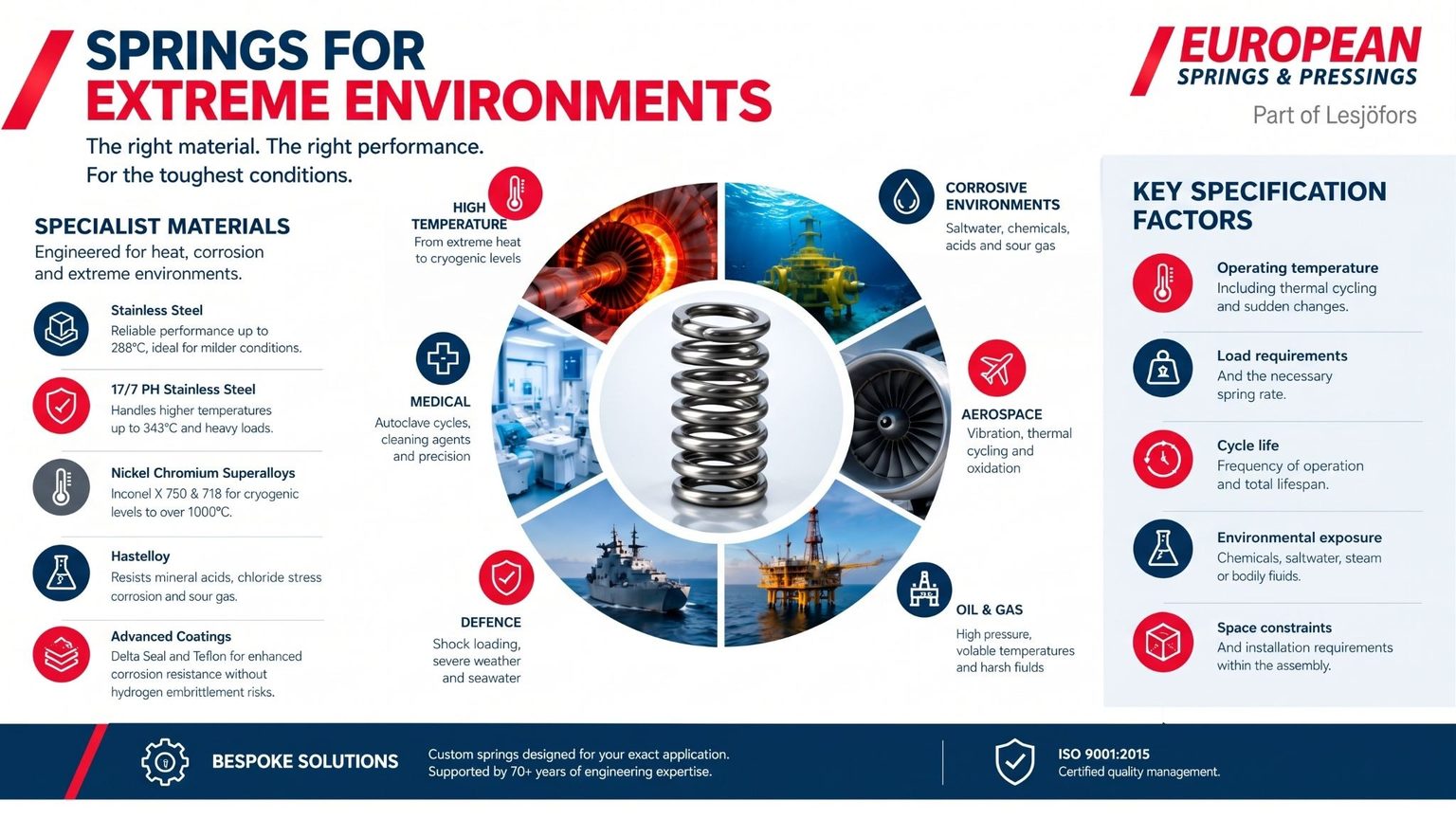
Selecting the right alloy requires matching material properties directly to expected thermal and corrosive threats. Standard Type 302 and 316 stainless steels perform reliably in mild conditions up to 260°C–288°C, but higher temperatures under heavy loads can cause severe load relaxation.
For higher stress applications up to 343°C, 17/7 PH stainless steel provides the necessary resistance to load relaxation, making it ideal for steam valve operations and chemical processing.
For extreme cryogenic environments or turbine exhausts, high-performance nickel-chromium superalloys maintain structural integrity. Inconel X-750 and 718 preserve mechanical strength with zero creep from cryogenic temperatures up to over 550°C to 700°C . Similarly, Hastelloy offers excellent resistance to mineral acids, chloride stress corrosion cracking, and aggressive downhole sour gas in energy extraction.
When superalloys aren’t necessary, advanced surface treatments provide effective protection. Delta Seal coatings deliver robust corrosion resistance without the risk of hydrogen embrittlement, while Teflon coatings create a resilient chemical shield operating from -190°C to 260°C.
How Extreme Environments Shape the Specification
The starting point for any technically complex component is always the application itself. A design that performs beautifully in a general industrial setting will likely fail when exposed to sustained thermal cycling. Before finalising any material choice, procurement teams and engineers must evaluate several overlapping factors.
- Expected operating temperature and the frequency of sudden thermal changes
- Specific load requirements and the necessary spring rate
- Frequency of operation alongside the total expected life cycle
- Direct exposure to aggressive chemicals, saltwater, steam or bodily fluids
- Strict space constraints and installation requirements within the final assembly
These details determine whether a tailored stainless steel is sufficient or if a specialist superalloy is required to prevent catastrophic failure.
Surviving Repeated Autoclave Sterilisation in Medical Devices
Medical components demand complete reliability and exact precision. A spring fitted inside a surgical tool, ventilator or drug delivery system must maintain a consistent force even after hundreds of cycles through high pressure autoclave sterilisation. These parts also face regular exposure to harsh cleaning agents and bodily fluids.
Material compatibility must align perfectly with dimensional accuracy to ensure the medical device performs flawlessly over its entire working life. We frequently manufacture medical components using Hastelloy and tailored stainless steels, ensuring the final product meets strict environmental and performance requirements.
Managing Heat and Vibration in Aerospace
Aerospace applications operate within incredibly tight design parameters. Components fitted within landing gear, actuators, flight control systems, and turbine engines endure intense vibration alongside rapid temperature fluctuations. Selecting thermally stable nickel-based alloys like Nimonic ensures the component resists thermal fatigue and oxidation.
An engineer specifying a part for a turbine environment must carefully calculate the actual operating heat, the specific loading pattern and the required fatigue life before settling on an alloy, as saving crucial weight remains a constant priority.
Oil and Gas Demands Deepwater Durability
The combination of crushing pressure, volatile temperatures and constant saltwater exposure makes offshore equipment incredibly challenging to design. A valve spring operating on the seabed must resist corrosive fluids and maintain its specified force indefinitely. Relying on basic strength figures will lead to failure. This is where bespoke engineering using specialist metals becomes necessary for drilling equipment, pressure vessels and pipeline assemblies.
Defence Applications Require Careful Material Selection
Defence equipment combines intense shock loading, rapid temperature changes and severe weather exposure. Naval equipment faces prolonged contact with seawater, leading to rapid degradation in standard metals.
Airborne systems encounter substantial atmospheric changes during deployment. Designing for the defence sector means taking account of the actual field environment rather than relying on a general material recommendation. We regularly work with Inconel and specialised steels to create naval and airborne equipment that survives the harshest possible field conditions.
Designing Bespoke Solutions for High Risk Projects
Standard components work fine for standard tasks where dimensions and operating conditions fit an established specification.
Severe applications always involve tighter requirements. A bespoke spring allows the engineering team to account for the available space, required force, geometry, material and cycle requirements simultaneously. Modifying the force characteristics of a custom spring ensures the entire wider assembly functions precisely as intended.
European Springs and Pressings brings over seven decades of manufacturing expertise to demanding market sectors. Our engineering team supports technically complex projects from initial prototyping right through to ISO 9001 certified production. If you are developing a component for a highly demanding environment, share your exact operating requirements with us. We will help you specify the correct material and design to ensure long term reliability.
Secure Your Project with Precision Engineering
Do not leave your next high risk project to chance with standard catalogue parts. When your components must survive extreme heat, intense vibration or corrosive chemicals, you need absolute engineering certainty.
Partner with European Springs and Pressings to develop a bespoke solution built specifically for your operating environment. Share your exact specifications with our technical team to lock in the right material and design for complete long term reliability. Request a quote for your specialist spring requirements today!