
When engineering a new mechanical assembly, component procurement often dictates both the timeline and success of a project. For engineers working to strict deadlines, immediate access to a massive stock inventory provides the rapid turnaround required to keep prototyping on schedule.
However, when applications demand extreme durability, precise load tolerances or performance in severe environments, standard off-the-shelf components are often pushed past their intended limits.
While stock springs offer exceptional value for general assemblies, custom spring design provides mathematically optimised parts for highly specialised applications. By engineering a spring to exact specifications, businesses benefit from an extended lifecycle, precise force control and access to specialised materials. The upfront costs of bespoke tooling are quickly offset by eliminating premature mechanical failures and drastically reducing ongoing maintenance.
Partnering with European Springs and Pressings means working with a single supplier or both standard and custom requirements. We offer one of the largest standard stock catalogues in Europe available for immediate dispatch, alongside advanced custom engineering facilities. This dual capability ensures your project moves seamlessly from rapid concept testing to high-performance mass production.
Where Standard Springs Excel and Where Custom Design Takes Over
Standard made to order springs work perfectly when operating conditions stay within predictable boundaries. They are highly effective for urgent facility maintenance, early-stage prototyping and general mechanical assemblies where spatial tolerances are flexible.
The limitations of standard components appear when engineering conditions become specific. This typically includes:
- Fixed housing dimensions with zero room for spatial adjustment
- Repeated load cycling that accelerates material fatigue
- Exposure to extreme heat, moisture or corrosive chemicals
- Requirements for highly consistent force over years of continuous operation
In these demanding situations, a standard catalogue spring inevitably involves compromise. The part may function initially, but a custom design guarantees optimal stability by aligning every physical and mechanical parameter directly with the application.
Prototyping to Production Without Redesign Friction
Many engineering teams begin with stock components during early prototyping when speed and flexibility matters above all else. This approach is highly practical and cost-effective. Problems only show when scaling up for mass production. If the final product relies on a standard component in a highly restricted space, the assembly design may need to be modified to accommodate standard catalogue dimensions.
Working with a dual-capability manufacturer resolves this complication. A highly efficient engineering workflow looks like this:
- Early-stage testing utilises our vast inventory of stock springs for rapid physical validation.
- Exact performance requirements and spatial limitations are defined through this testing data.
- Custom springs are then engineered to match those validated requirements exactly.
This creates a seamless transition from prototype to production. You avoid redesigning your assembly around standard component sizes and eliminate the risk of late-stage mechanical failures caused by tolerance mismatches.
The Financial ROI of Custom Engineering
Custom spring design is frequently evaluated solely through upfront tooling cost. That limited view misses the true financial picture.
Stock springs offer excellent value and reduce initial expenditure for general applications.
However, if they are placed into highly demanding or corrosive environments, they automatically require more frequent replacement. Each replacement introduces machinery downtime, labour costs and operational disruption.
Custom springs completely shift this cost structure. The initial investment is higher due to engineering input, but long-term performance offsets this through:
- Drastically reduced failure rates
- Lower maintenance frequency
- Improved total system uptime
- Extended operational lifespan
The most accurate comparison is total lifecycle cost. In industrial applications where equipment downtime is expensive, the financial shift in favour of precision manufacturing becomes obvious within the first operating cycle.
Specialised Material Selection for Severe Environments
A key advantage of custom spring manufacturing is full control over material selection.
Stock options are typically manufactured using standard carbon steels and common stainless grades. These materials perform exceptionally well in everyday applications but degrade under extreme conditions.
Custom spring manufacturing allows you to select materials based on the operating environment rather than basic availability. European Springs and Pressings regularly processes exotic alloys to ensure survival in extreme scenarios. Bespoke springs can utilise advanced materials such as Inconel, Hastelloy, Elgiloy, phosphor-bronze and titanium.
This ensures the component survives extreme temperatures, high-vibration scenarios, and highly corrosive environments. The spring is chemically and mechanically suited to survive the application, determining whether a component lasts months or decades in service.
Calculating Exact Tolerances and Spring Rates
A custom spring is defined by precise mathematical specification rather than simple catalogue selection. This includes defining the exact wire diameter, coil geometry, active coils and end configurations.
Custom designs allow for exact spring rates (calculated as F = k × x where force equals the spring constant multiplied by the extension distance). Instead of operating within a standardised tolerance range designed for general use, the bespoke spring is engineered for a highly specific force profile. This reduces mechanical uncertainty and improves repeatability across millions of production batches.
To discuss your requirements in more detail, request a quote from our technical team today. Whether you need rapid stock supply for urgent maintenance or a fully engineered bespoke solution for a complex application, European Springs and Pressings will align performance, lead time and cost to your exact specifications.
Frequently Asked Questions
What are the differences in materials between standard and custom springs?
Standard springs are generally manufactured using carbon steel or basic stainless steel for cost efficiency and general use. Custom springs provide access to exotic alloys like titanium, beryllium copper and Inconel, which are engineered specifically to withstand corrosive environments, cryogenic temperatures or extreme heat.
How does spring prototyping work?
Prototyping involves using readily available stock springs to test basic mechanical functions and spatial fits within a new design. Once the engineers gather real-world data regarding load requirements and fatigue, a custom spring is mathematically designed to optimise those specific parameters for the final production run.
How do you calculate the spring rate for a specific project?
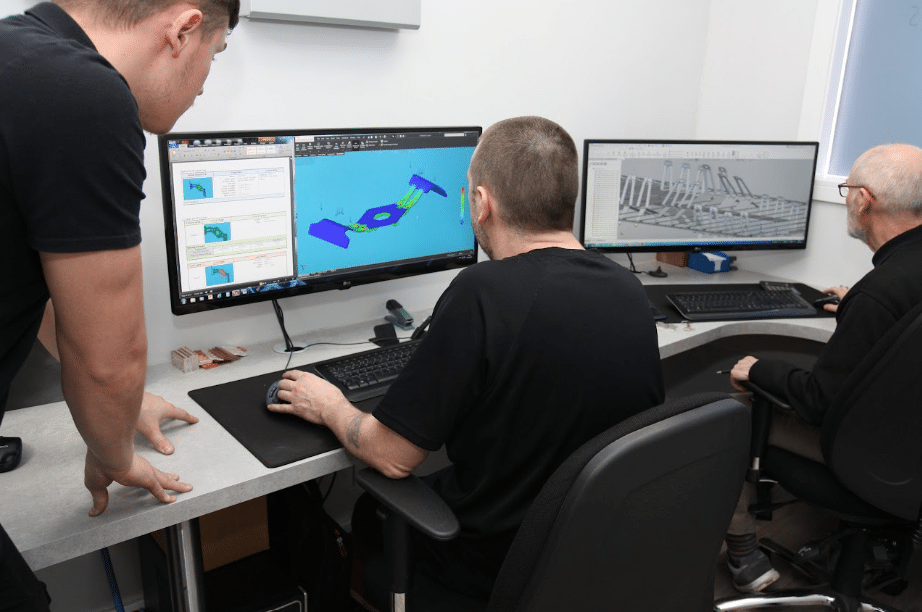
The spring rate determines how much weight is required to compress or extend a spring by a specific distance. Our engineers use advanced CAD software and rigorous mathematical formulas to analyse wire diameter, coil diameter, and the number of active coils, achieving the exact force response required for your assembly.
Why choose a manufacturer with both stock and custom capabilities?
A dual-capability manufacturer provides standard parts for immediate urgent testing while retaining the technical expertise to engineer custom solutions for your final product. This prevents supply chain disruptions and ensures you never have to change suppliers midway through a critical project.